Best Time to Visit Amsterdam: Month by Month (2026)
The best time to visit Amsterdam, month by month: weather, crowds, tulip timing, and the parking and emission-zone rules that make a car a bad idea.
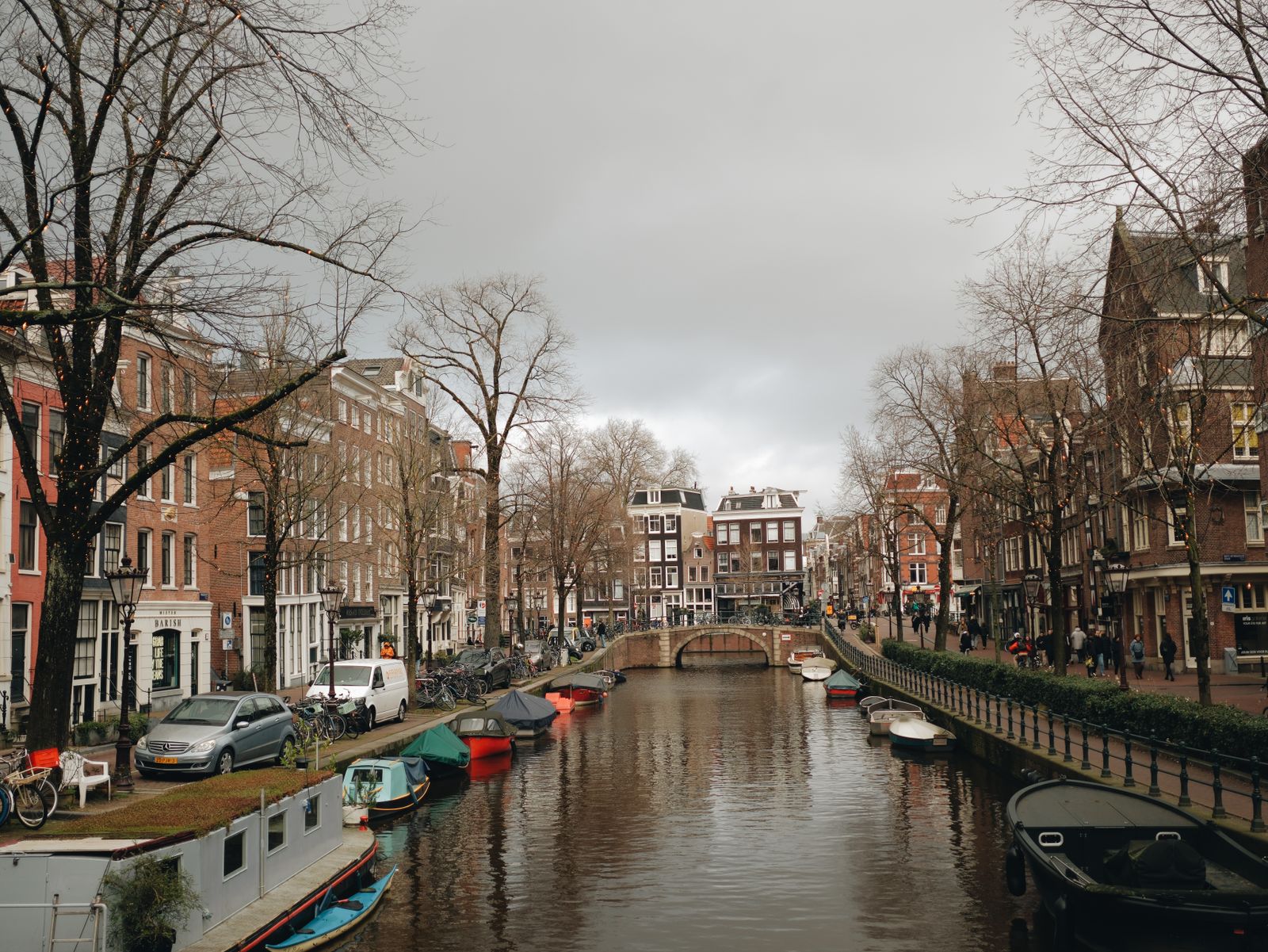
Most guides answer the question of the best time to visit Amsterdam the same way: April and May for the tulips, September for the weather, avoid summer. That is broadly right and it leaves out the two things that actually shape a trip — how much the same hotel room costs across the year, and the fact that arriving by car in Amsterdam is a specific and expensive mistake. This guide covers both.
Best time to visit Amsterdam: the short answer
If you are optimising for weather plus crowds, go in September. Days are mild, the light is still long, the summer peak and cruise traffic have eased, and hotel rates have already begun sliding.
If you want tulips, you have exactly one window: mid-April to early May. It is also the busiest and most expensive stretch of the year, and that is not a coincidence.
If you are optimising for price and quiet, go in November, January or February. Amsterdam in winter is cold and grey, but the Van Gogh Museum and the Anne Frank House stop being an exercise in queueing, and flights and hotels are at their cheapest.
The months to think twice about are July and August, when European school holidays, international tourism and cruise arrivals stack on top of each other.
Amsterdam month by month
January. The calmest month of the year, and one of the cheapest. Cold, dark and often wet, but the museums are genuinely walkable and hotel rates are at the floor. A good month for indoor Amsterdam.
February. Same profile as January with marginally more light. Still cold, still cheap, still quiet.
March. The turn. Weather is unreliable, but the city starts to reopen outdoors and the first bulb fields begin to show colour towards the end of the month.
April. The most popular month, and for one reason: tulips. King’s Day on 27 April turns the whole city into a street party — a great experience if that is what you came for, an obstacle if it is not. Book far ahead either way.
May. Arguably the best all-round month for weather. Long days, everything open, the tail of the tulip season in the first week. Busy and priced accordingly.
June. Warm, long evenings, and the beginning of peak. Early June is still comfortable; late June starts to feel like summer proper.
July. Peak season. Museum queues are at their worst, the canals are busy, and prices are at their highest.
August. Same as July with slightly more humidity. If you must come in summer, book the timed-entry museums the moment they release.
September. The best month of the second half of the year. Mild, noticeably quieter than August, and cheaper as summer rates unwind.
October. Autumn colour along the canals, cool but workable weather, and the last of the shoulder-season prices before winter. Underrated.
November. The value month. Cold, grey, very quiet, and the cheapest flights of the year alongside January and February. The Amsterdam Light Festival typically starts around the end of the month and runs through winter, which changes the evening city completely.
December. Two months in one. Most of it is cheap, dark and calm, with the Light Festival along the canals and Christmas markets. The Christmas-to-New-Year stretch is the exception, when prices jump.
What almost no guide tells you: the car is a trap
Here is the practical half. Amsterdam is one of the few major European cities where arriving by car is not merely inconvenient but actively expensive, and the reasons are worth knowing before you book anything.
On-street parking is punishing. Central-district rates are commonly quoted in the €5-8 per hour range depending on the zone and the time of day. A single afternoon parked in the centre can cost more than a day of car rental.
The whole area inside the A10 ring is a low emission zone (milieuzone). For cars, the operative rule is that diesels must be Euro 5 or better. There is no sticker to buy and nothing to register — enforcement runs off number plate recognition — and getting it wrong costs a fine in the €110-130 region. A modern rental car will normally comply, but it is a two-second question to ask at the desk, and the answer is the difference between nothing and a fine that arrives weeks later.
The city is built against you. Narrow canal streets, one-way systems, bridges, trams that always have priority, and cyclists who very much do not expect you. Amsterdam works brilliantly on foot, by tram and by bike; a car in the centre is a liability in every dimension.
The answer is P+R. Amsterdam runs a network of park-and-ride sites on the edge of the city, connected to the centre by metro or tram. Rates are around €6 per 24 hours if you arrive after 10:00 on a weekday or at any time at the weekend, with a higher first-day charge for early weekday arrivals, and a maximum stay of four days at most locations. It is an order of magnitude cheaper than the centre and it puts you outside the emission zone by design.
Everything inside the A10 ring is the emission zone — and the area where parking stops being worth it.
Official Low and zero emission zone rules (City of Amsterdam)When a car does earn its place
None of the above means you should never rent one. It means you should rent it for the right part of the trip.
A car pays for itself the moment Amsterdam becomes a base rather than the destination:
- The bulb fields around Lisse and the Bollenstreek in late April, which are scattered across country roads and awkward to reach otherwise.
- Zaanse Schans, Volendam and Marken, the classic day-trip triangle north of the city.
- Kinderdijk, Delft, Utrecht and The Hague, if you are stitching together several Dutch cities.
- A wider route into Belgium or Germany, where the Netherlands’ compact size starts to work in your favour — and where it is worth reading up on crossing borders in a rental car first, because insurance territory limits are set per contract, not per continent.
The pattern that works: do the city days car-free, then pick the car up on the morning you leave. If you want to see how the rate moves across the calendar, you can compare car rental prices in Amsterdam for your dates — the gap between a November week and a late-April one is one of the widest in Western Europe, for exactly the same reasons the hotels move.
It is also worth checking what your rental insurance covers in Europe before you get to the desk, and — if the Netherlands is one leg of something longer — whether a one-way rental beats doubling back.
Driving in the Netherlands, briefly
If you do drive, three things catch visitors out:
- Motorway speed limits are time-dependent. The general daytime limit is 100 km/h from 06:00 to 19:00, rising to 120 or 130 km/h on some stretches outside those hours. It is signposted, but it is not what most foreign drivers expect.
- Cyclists have priority far more often than you think, including on roundabouts and at side roads. Assume the bike is going first.
- Enforcement is heavy and automatic. Average-speed cameras cover long motorway sections, and fines reach a rental company months later with an administration fee attached.
A weekend in Amsterdam, or longer?
A weekend in Amsterdam is enough for the core: the canal belt on foot, one or two of the big museums, and an evening in the Jordaan or De Pijp. The constraint is not distance — the centre is small — it is timed entry. The Anne Frank House and the Van Gogh Museum release tickets on a schedule and sell out well ahead in every month except deep winter.
Three or four days is where an Amsterdam itinerary stops feeling compressed: you get a day for the museums, a day for the canals and neighbourhoods, and a day out of the city. That third day is the one where a car changes what is possible.
Amsterdam rewards travellers who make two decisions early. Pick the month for what you are actually optimising — tulips, weather, or price, because no single month gives you all three — and decide before booking whether the car belongs to the trip at all. In most Amsterdam trips, the honest answer is that it belongs to the last two days, not the first two.
Ready to book your car?
Compare prices, free cancellation and pay at pickup. No surprises.
View rental prices →