Best Time to Visit Venice: Month by Month (2026)
The best time to visit Venice, month by month: crowds, acqua alta after MOSE, the 60 days the access fee actually applies in 2026, and where the car stops.
Every guide answers the question of the best time to visit Venice with the same two words: spring or autumn. That is not wrong, and it also skips the three things that actually determine whether your trip goes well — whether acqua alta will reach your shoes, whether you will be charged to enter the city, and what happens to your car when the road physically runs out. This guide covers the calendar and all three.
Best time to visit Venice: the short answer
October is the best all-round month. Temperatures of 14-18 °C are close to ideal for a city you cross entirely on foot, the autumn light is the reason photographers keep coming back, the crowds have thinned substantially from summer, and the concert, exhibition and theatre season is running. The acqua alta season starts in late October, but at that stage it is usually limited to minor episodes.
November is the most underrated month and the quietest. The tourist infrastructure is still fully operational, but the city is calm in a way summer visitors never see. The trade-off is real: it is historically one of the highest-risk months for acqua alta, and one of the wettest.
Late April and May are the alternative for warmer weather, at the price of crowds and rates that approach peak.
The months to think twice about are July and August, which combine heat, humidity, cruise arrivals and the highest prices of the year.
Venice month by month
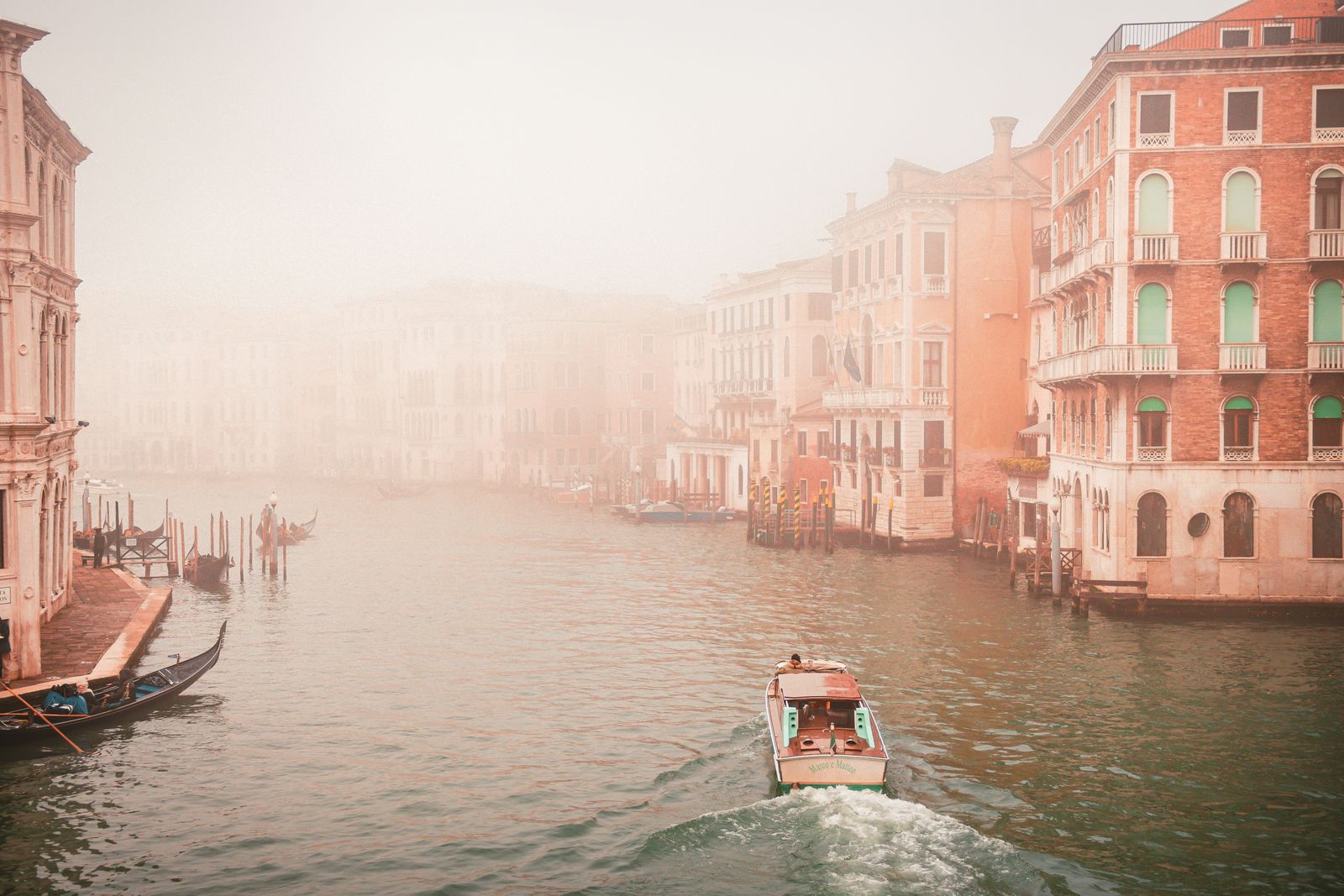
January. The quietest and cheapest month. Cold (highs around 6-8 °C), often foggy, and the fog is genuinely part of the appeal — the Grand Canal disappearing into grey is a very Venetian sight. Museums have no queues.
February. Split in two by Carnevale, which fills the city for roughly two weeks and pushes prices to summer levels. Outside those dates, February is as quiet as January.
March. Cold at the start, noticeably better by the end. Prices are still low and the city is waking up.
April. One of the best months, with the caveat that Easter and the 25 April holiday (St Mark’s Day, the city’s patron) bring sharp crowd spikes. Check the dates before booking.
May. Warm, long days, everything open — and busy. Rates approach peak.
June. Hot and full. The first half is still manageable; by the end it is high summer.
July and August. The hardest months. Heat, humidity, mosquitoes near the water at dusk, and the maximum crowd. Also the two months when the access fee has historically applied on some days.
September. The heat breaks in the second half and the month becomes a near-copy of October with slightly warmer water and slightly more people. The Venice Film Festival, at the start of the month, is a local spike worth knowing about.
October. The best all-rounder, as above.
November. Quietest, wettest, highest acqua alta risk, best value.
December. Two months in one. Until roughly the 22nd it is calm, lit up and cheap, with Santa Lucia on the 13th as the most local date of the year. Christmas to New Year brings the crowd and the prices back, with fireworks over the Grand Canal on the 31st.
The access fee: only 60 days in 2026
Here is the single most misreported fact about visiting Venice.
Venice charges a contributo di accesso to day visitors — people who do not stay overnight — but not all year round. In 2026 it applied on exactly 60 days between 3 April and 26 July, and only between 08:30 and 16:00. The rate was €5 for bookings made at least four days ahead and €10 otherwise, for visitors aged 14 and over.
What that means in practice: outside that window, and outside those hours, a day visitor pays nothing. An October or November trip does not trigger it at all. The calendar is set by the city each year, so confirm it for your own travel dates rather than trusting a blog table — including this one.
Do not confuse it with the overnight tourist tax, which is a separate charge collected per person per night by your hotel or apartment, and which applies year-round.
Official Access fee: calendar and payment (City of Venice)Acqua alta and what MOSE changed
Acqua alta is the exceptional high tide that floods the lowest parts of the city, above all St Mark’s Square, which is the deepest point of the historic centre. Its season runs from autumn to early spring, peaking roughly October to December.
The part most guides have not updated: since 2020 the MOSE system has been operational — 78 mobile barriers across the three inlets of the lagoon, raised when a significant high tide is forecast. The result is that events which used to put large parts of the centre under water are now rare. The barriers are raised frequently; the city keeps functioning.
That does not mean you can ignore it. Minor tides still wet quaysides and low walkways, and the decision to raise depends on a forecast that is sometimes short. Two sensible habits: check the city’s tide forecast the evening before, and pack genuinely waterproof boots rather than fabric trainers. Boots are also sold and rented all over the city if you get caught out.
The car stops at Piazzale Roma
This is not advice, it is geography. Venice has no streets a car can drive on. The causeway from the mainland ends in exactly two places — Piazzale Roma and the artificial island of Tronchetto — and beyond that there are only footways, stepped bridges and water.
So the question is never where to park near your hotel. It is which of three options you choose:
- Piazzale Roma — closest and dearest, commonly €35-50 a day. You step out of the car and you are already in Venice.
- Tronchetto — the large multi-storey just before it, usually €20-30 per 24 hours, connected to Piazzale Roma by the People Mover in a few minutes. The sensible middle option.
- Mestre or Marghera — on the mainland, from around €5-7 a day, with a train or bus into Venice in 15-20 minutes. On a multi-day trip where the car stays put, this is almost always the cheapest total.
Piazzale Roma and Tronchetto: the two points where the road ends and Venice begins.
When a car earns its place
Inside Venice, never. Outside it, quickly — and the Veneto in the shoulder season is one of the better driving regions in Italy:
- Verona — about 120 km, an hour and a half on the A4. In December it also has the large Christmas market Venice does not.
- Padua — 40 km, half an hour. Giotto’s frescoes in the Scrovegni Chapel and a proper university city.
- Treviso and Bassano del Grappa — 30-70 km, the Veneto of canals and arcades with almost no tourism outside summer.
- The Dolomites — Cortina d’Ampezzo is about 160 km, two hours, and the one trip that needs real planning in winter.
If that is the shape of your trip, you can compare car rental prices in Venice for your dates and pick the days you actually need it, rather than paying for a car that sits in a garage while you are on an island.
Two things to read before you set off: how the Italian toll system works, since the A4 and A27 are both ticket-and-pay motorways, and the rules of the road in driving in Italy — especially the ZTL restricted zones, which catch out visitors in Verona, Padua and Treviso just as reliably as in Rome. Our guide to ZTL fines with a rental car covers how the charge reaches you months later with an administration fee attached.
Winter tyres are also worth checking: in the Veneto, winter tyres or chains on board are required from 15 November to 15 April on the affected motorways, including the A4 Venice-Trieste with the Mestre bypass, and the A28.
Weekend, or longer?
A weekend in Venice covers the core comfortably: St Mark’s Square and the Basilica, the Rialto, one major museum, and a long walk through Dorsoduro or Cannaregio away from the main flow. The trick is to walk the routes the crowd does not — Venice empties dramatically two streets off the Rialto-San Marco axis.
Three days is where the lagoon islands stop being a rushed add-on. Murano, Burano and Torcello take the best part of a day by vaporetto and are worth it.
If you are pairing Venice with another Italian city, the same monthly logic applies but the answers differ — we broke it down in the best time to visit Rome, where the crowd curve and the heat behave quite differently.
Venice rewards two decisions made before booking: pick the month for what you are actually optimising, because October, November and January each win on a different metric and none wins on all three — and accept that the car is not part of the city, only of the region around it.
Ready to book your car?
Compare prices, free cancellation and pay at pickup. No surprises.
View rental prices →