Driving in Italy: ZTL Fines, Speed Cameras, Tolls and Parking Explained
Driving in Italy: how ZTL fines really reach you, speed camera tolerance, autostrada tolls and parking rules — plus when a rental car is worth it.

You can drive through Italy without a single speeding ticket, without missing a turn, without doing anything that feels remotely like a violation — and still find a fine on your card statement eight months after you’ve flown home. That’s not travel-blog scaremongering. It’s just how the camera system in Italian cities actually works, and it trips up more rental car customers than speeding, tolls or bad parking combined.
The good news: once you know the handful of rules that actually bite, driving in Italy is genuinely easy. The roads are well-maintained, signage is decent, and the difficult bit is entirely avoidable once you understand it.
The ZTL: how the fine actually finds you
The ZTL (Zona a Traffico Limitato) is a restricted zone covering the historic centre of almost every Italian city — Rome, Florence, Milan, Bologna, Naples, Siena, Pisa, Lucca. Only residents and authorised vehicles can drive in. There’s no barrier and nobody stops you: a camera at the boundary reads your plate, and if you’re not on the approved list, that’s it. You won’t feel a thing at the time, which is exactly the problem.
The sign to watch for is a plain white circle with a red border, sometimes with a small screen underneath showing the active hours. GPS apps do not reliably route around ZTLs — they’ll happily send you straight through one to save two minutes, so don’t drive on autopilot near any old town centre.
What happens after you cross it is the part nobody explains well: under Italian law, the authorities have up to 90 days to notify the registered keeper of the car — which is the rental company, not you. The rental company then has 60 days to hand over the renter’s details. Only after that do local authorities have up to 360 days to actually mail the fine to your home address. Add it up and the better part of a year between the trip and the letter is completely normal, not a glitch.
Two separate charges usually show up, at different times, for the same crossing:
- The rental company’s own administration fee for processing the request and handing over your details — typically €30–€60, charged fairly soon after they’re notified.
- The municipal fine itself, which follows later by post — commonly €80–€110 in most cities, though some local fee schedules run considerably higher. Pay within 5 days of the official notice and most towns knock 30% off.
If your hotel sits inside a ZTL, they can usually register your plate with the local authority — but ask before you assume it covers everything. It’s often a single authorised entry and a single exit, not open access for the length of your stay. Send the plate number and your dates ahead of time, get confirmation in writing, and follow the exact route they give you.
Speed limits — and how much tolerance you really get
| Road type | Limit |
|---|---|
| Built-up areas | 50 km/h |
| Ordinary roads | 90 km/h |
| Dual carriageways | 110 km/h |
| Motorways (autostrada) | 130 km/h |
Drivers who’ve held a licence for under three years lose 10 km/h off the two highest limits. Headlights (dipped beam) are compulsory outside built-up areas during the day, not just at night — most rental cars handle this automatically with daytime running lights, but check at pickup.
Enforcement runs on two different systems, and they behave differently. Fixed Autovelox cameras give a small buffer — roughly 5 km/h under 100 km/h, and about 5% above that. The one people misunderstand is Tutor: pairs of gantries on long autostrada stretches that measure your average speed across the whole section, not your speed at any single point. Slowing down for the camera and speeding up again afterwards changes nothing — the system already has your average.
On the motorway, stick to the right lane unless you’re overtaking. Sitting in the left lane gets you flashed by the car behind — it’s a standard prompt to move over, not road rage. In southern cities like Naples and Palermo, junctions run more on negotiation than strict priority; advance steadily and signal your intention, since hesitating causes more trouble than committing.
Tolls: paying the autostrada without slowing anyone down
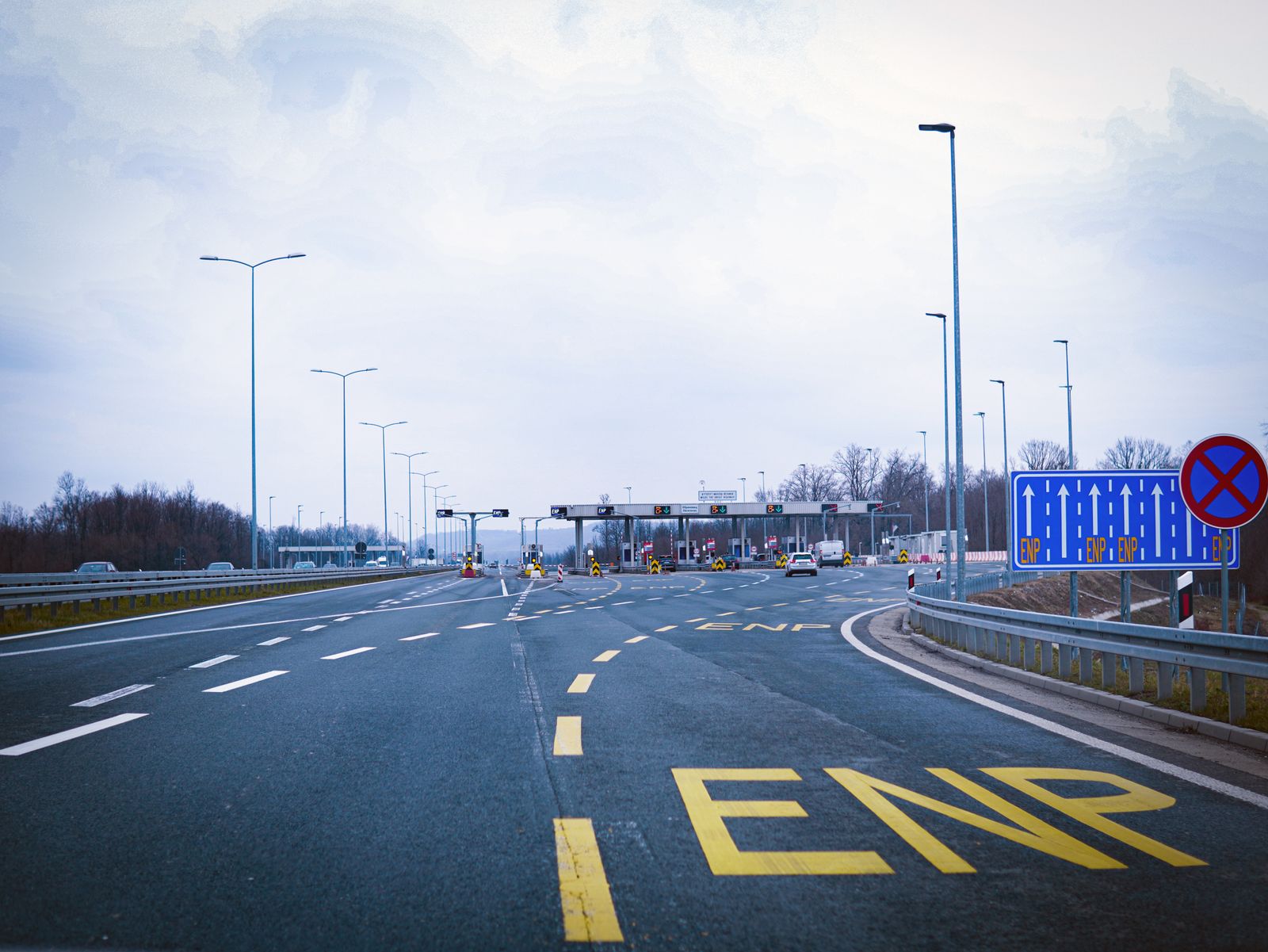
Italy’s motorways (autostrade, green signage) are toll roads. You take a ticket on entry and pay based on distance at the exit — budget roughly €10 per 100 km as a rule of thumb. At the barrier, pick a white lane for cash or card. The blue lanes marked with a yellow “T” are Telepass-only: drift into one without the transponder and you’ll block the queue behind you, sometimes with a fine attached.
Some rental companies offer a Telepass device as a paid extra for longer trips with heavy motorway mileage; for a short holiday or a countryside-only route, it’s not worth the add-on cost. Our full breakdown of toll roads in Italy covers Telepass, the lane system and what happens if you lose your entry ticket.
Parking: the colour code that keeps you out of trouble
- White lines — free. Rare in centres, more common in residential streets and smaller towns.
- Blue lines — paid. Buy a ticket at the nearest parcometro or pay via an app like EasyPark, and leave the ticket visible on the dashboard. In smaller towns, blue spaces are often free on Sundays and overnight — check the posted hours.
- Yellow lines — reserved: residents, deliveries, disabled bays, taxis. Don’t gamble on these; towing crews work these streets routinely.
The safest move in any Italian city is a covered parcheggio just outside the old walls, or a parcheggio scambiatore (park-and-ride) at the edge of town, then walking or taking the bus in. It keeps the car out of the ZTL entirely and away from the “zona rimozione” tow zones. Don’t leave anything visible on the seats, especially at coastal viewpoints and tourist car parks.
Alcohol, phones and Italy’s tougher new rulebook
Italy overhauled its traffic code in December 2024, and the penalties for the things tourists actually do wrong got noticeably steeper. The alcohol limit is 0.5 g/l for most drivers and 0.0 g/l for anyone who’s held a licence for under three years. Between 0.5 and 0.8 g/l, the fine runs €573–€2,170 with a licence suspension of 3 to 6 months; above 0.8 g/l it becomes a criminal offence, with fines up to €6,000 and possible jail time at the upper end. Repeat offenders can only drive cars fitted with an alcolock.
Using a phone at the wheel now carries a €250–€1,000 fine and a 7-to-15-day licence withdrawal on a first offence, rising to €1,400 for a repeat within two years — and a foreign licence doesn’t shield you from the financial penalty.
The practical version: no drinking if you’re driving that day, and the phone goes in a mount with the route already set before you pull away.
When a car actually earns its keep
Inside Rome, Florence, Venice or Naples, a car is a liability — ZTL cameras, scarce parking and traffic that moves faster on foot. Outside them, it’s the opposite: rural Tuscany, the Dolomites, inland Puglia and the hill towns above the Amalfi Coast are exactly where public transport runs out and a rental car starts paying for itself. Our full regional breakdown of where to rent a car in Italy goes through this city-by-city if your trip mixes both.
Compare rental car offers in Italy →
Sicily deserves its own mention here: the coastal cities have trains and Flixbus routes that cover the basics, but the interior — Agrigento, the Val di Noto, Etna’s back roads — is a different story once you leave the coast. Our guide to getting around Sicily breaks down exactly where the train network stops and a car becomes the only practical option.
Best road trips if you do rent
Chiantigiana (SR222), Tuscany — Florence to Siena through the Chianti vineyards via Greve in Chianti, Panzano and Castellina. Slow and winding by design, built for stopping every few kilometres.
Amalfi Coast (SS163) — Sorrento to Salerno via Positano and Amalfi. Spectacular and narrow; drive it early morning, since tour coaches make it genuinely difficult from mid-morning in summer.
Lake Como circuit — either direction around the lake, stopping at Bellagio and Varenna. The western shore road is the better of the two.
Grande Strada delle Dolomiti (SS48/SS51) — Bolzano to Cortina d’Ampezzo over the Sella and Falzarego passes. Best from late May to October; some passes close for winter.
Before you pick up the keys
- Licence: an EU licence is valid as issued. Non-EU drivers need an IDP or certified translation under Article 135 — bring it even if the desk doesn’t ask.
- Credit card in the main driver’s name: required for the deposit at almost every Italian rental company.
- Read the excess before you book, not at the arrivals hall counter — Italy’s base excess can run high, and add-on cover varies a lot between suppliers.
- ZTL awareness: if your hotel sits inside one, sort the plate registration before you land, not after you’ve already crossed the boundary.
Get the ZTL and the parking colours right, and Italy is one of the easiest countries in Europe to drive — good roads, clear signage, and scenery that makes every wrong turn forgivable except the one with a camera on it.
Ready to book your car?
Compare prices, free cancellation and pay at pickup. No surprises.
View rental prices →