Driving in Morocco: What It's Really Like Behind the Wheel
Do you actually need an international permit to drive in Morocco? How tolls, police checkpoints, Atlas passes and night driving really work — corrected for 2026.
Morocco is one of the most rewarding countries to drive in the region, and one of the most over-warned about. The autoroutes are modern, fast and genuinely cheap. The mountain passes are dramatic and, on the paved sections, entirely manageable in a normal rental car. The medinas are a maze you were never meant to enter with a car in the first place. Once you know which is which, the whole trip gets a lot simpler — and a few things repeated across older guides (an international permit everyone supposedly needs, tolls you can allegedly only pay in cash) just aren’t accurate anymore.
The practical version: you can cover huge distances by car here, the roads between cities are better than most first-timers expect, and the things that actually catch people out are police checkpoints they weren’t expecting to be routine, mountain roads that turn to piste without warning, and driving after dark.
Do you actually need an international driving permit?
Short answer: probably not, and it’s worth clearing this up because it gets repeated wrong constantly. If your licence is from the EU, UK, US, Canada, Australia or New Zealand and it’s printed in Latin characters, a valid national licence is legally enough to drive in Morocco for stays of up to a year — no International Driving Permit required by law. That matches Moroccan traffic code and it’s also what most rental companies confirm when you ask them directly.
Where an IDP actually matters: if your home licence isn’t in Latin script (Arabic, Cyrillic, Chinese and so on), get an official translation or an IDP before you fly — neither can be arranged once you land. And a handful of rental desks ask for one anyway as an extra layer of paperwork, purely as their own policy, not a legal requirement. If you happen to already have an IDP from a previous trip, bring it — it costs nothing and occasionally saves five minutes of explaining at a checkpoint. If you don’t have one, don’t panic and don’t pay for an expedited one you don’t need.
You do need to carry your passport, the rental agreement and the vehicle registration papers at all times — these get checked routinely, IDP or not.
Morocco drives on the right.
If you’re weighing your options, compare current rental car rates for Morocco here before you lock in dates — prices move a fair bit by city and season.
Autoroutes and toll roads
The motorway network connecting Tangier, Rabat, Casablanca, Marrakech and Agadir is genuinely good — dual carriageway, well signed, fast, and a lot cheaper than European tolls for the distance covered. One thing worth correcting here too: this isn’t a cash-only system anymore. Autoroutes du Maroc (ADM) plazas mostly accept Visa and Mastercard alongside cash, and regular users can pick up a prepaid Jawaz tag for faster lanes. Still, keep some dirhams in the car — smaller interchanges and rural toll points are where card readers occasionally go down.
The Casablanca–Marrakech autoroute takes around three hours. Tangier to Casablanca is roughly four. Both are comfortable, unremarkable drives — which, if you’ve read scarier things about Moroccan roads, is exactly the point.
Outside the autoroute network, national routes (the N-roads) connect secondary cities and regions. Mostly paved and fine in a standard car, but narrower, slower and shared with a lot more than just cars — allow more time than the distance on the map suggests.
Police checkpoints: what actually happens
Checkpoints are constant — on every main route, at city entrances and exits, not just at borders. This is the single thing first-time visitors worry about most before the trip and the thing almost everyone reports as a non-event afterward. Slow down well before the barrier, stop when waved down, and hand over your passport, licence and rental papers when asked. Officers check documents and seatbelts, and you’re usually moving again inside a minute if everything’s in order. A local trick worth knowing: if an oncoming car flashes its headlights at you, there’s a checkpoint (or occasionally a hazard) just ahead — ease off the accelerator.
Experiences do vary once you’re off the main tourist corridors. Away from Marrakech–Agadir–Casablanca, a small number of travellers report officers hinting at an on-the-spot “fine” for an invented infraction. Staying calm, asking for a written receipt, and not handing over cash without one resolves the vast majority of these. It’s the exception, not the rule — but it’s real enough that forums mention it repeatedly, so it’s worth going in prepared rather than surprised.
City driving: patience over speed
Marrakech, Casablanca and Fès at rush hour are the closest thing Morocco has to genuinely stressful driving. Lanes are more of a suggestion, mopeds thread through gaps a car can’t, and at some junctions the traffic light is mounted to the side rather than straight ahead — easy to miss if you’re looking where a European light would be. None of this needs advanced driving skill, just a slower pace and more following distance than feels natural at first.
The medina of Marrakech is closed to private vehicles in the historic core, full stop. Parking is available in several supervised car parks on the perimeter — Parking Bab Doukkala, near the Koutoubia, and others — usually watched by an attendant for a couple of dirhams. Park there and walk in; attempting to navigate the medina’s lanes by car is not a strategy, it’s a way to get the wing mirrors clipped off. The same goes for Fès, Essaouira and Chefchaouen.
For the full breakdown of booking, insurance and what to carry, see our companion guide to renting a car in Morocco.
Atlas Mountains: paved passes, and where paved stops
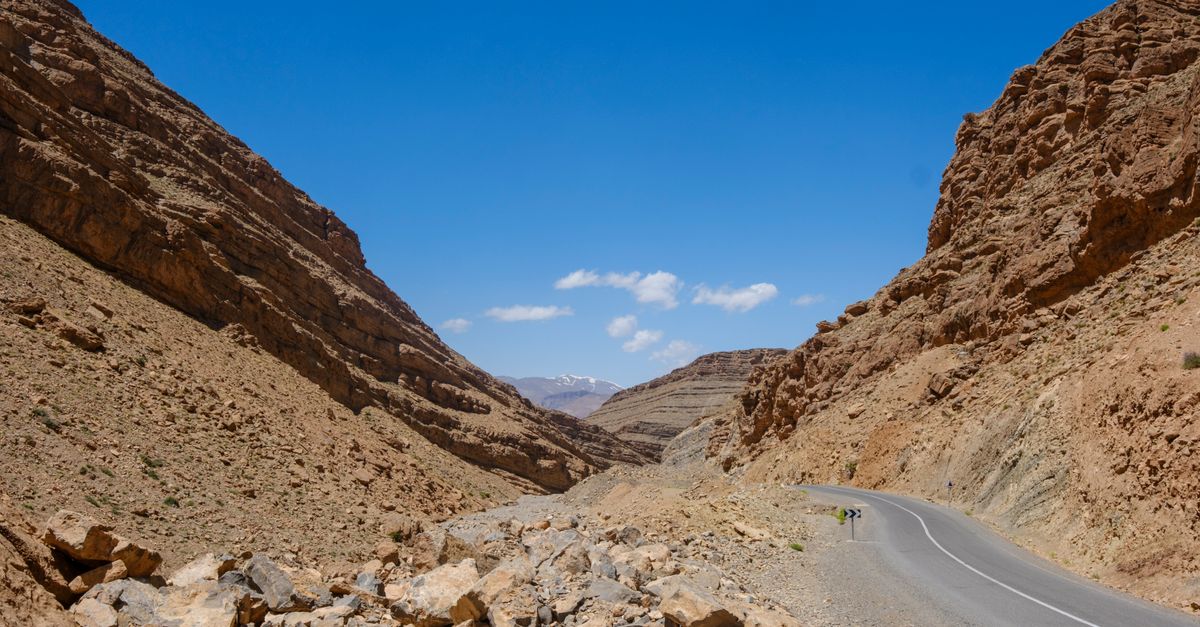
The paved mountain routes are accessible in a standard car, no 4x4 required. The N9 over the Tizi n’Tichka pass (2,260 m) from Marrakech toward Ouarzazate is fully surfaced and one of the most scenic drives in the country — it’s also narrow, switchback-heavy, and shared with buses and trucks that routinely cross the centre line on blind bends. Sound your horn before you can’t see round a corner; it’s standard practice here, not rudeness. Budget more time than the map distance suggests and don’t push to overtake on the bends yourself.
The N9 continues south to the Draa Valley. The Dadès Gorge road is paved for most of its length; the upper section near the hairpin bends turns to piste. The approach to the Erg Chebbi dunes at Merzouga is paved right up to the village — stop there, don’t attempt to drive onto the dunes themselves.
The part that actually matters for your wallet: most rental contracts explicitly exclude damage on unsurfaced roads. Drive a piste and scrape the underside, and CDW or SCDW typically won’t cover it — you’re liable for the full repair. If your route includes real gravel tracks rather than just the paved approach roads, either book a 4x4 with off-road cover or get written confirmation your contract allows it before you leave the tarmac.
For stretches like these, a 4x4 with off-road cover confirmed in writing is the safer call than assuming a standard hatchback will handle it.
Fuel: fill up before going south
Fuel stations are plentiful in and around cities. As you head south into the Draa Valley, the pre-Saharan area or the interior south of Ouarzazate, gaps between stations increase significantly — some travellers have gone over an hour between working pumps on the routes past Zagora. Fill the tank in every town you pass through and don’t rely on finding fuel when the gauge is near empty. Diesel (gasoil) is the default for most rental cars; check which one you’ve got at pickup, since putting the wrong fuel in is an expensive mistake insurance won’t touch.
Night driving: the one rule almost everyone repeats
Every experienced Morocco driver, guidebook and forum thread converges on the same advice: avoid driving outside cities after dark if you can help it. It’s not that the roads themselves are dangerous — it’s the combination of no street lighting, potholes and speed bumps that appear with zero warning, and donkeys, sheep and stray dogs on the road with no reflectors and no reason to expect headlights. During the day, all of this is easy to see and avoid. At night, it isn’t. If a drive is going to run past sunset, plan to stop in a town rather than push on to the next one.
Which base to start from
Marrakech is the best base for the Atlas Mountains, the south and the desert routes. Most car rental agencies have a strong presence here and price competition is reasonable.
Agadir suits a coastal trip along the Atlantic, with better access to Essaouira and the Souss Valley. It’s the calmest starting city for a first-time driver in Morocco.
Casablanca is the practical choice if you’re arriving on a transatlantic flight or want to combine the north (Tangier, Rabat) with the centre. The airport has all the major suppliers.
Practical notes
Speed limits are 40 km/h through villages and towns (some wider avenues run to 60), 100 km/h on national roads and 120 km/h on autoroutes. Both fixed and mobile radar are common, especially at the edges of villages, and fines are collected on the spot.
Cash in dirhams still matters more here than in most European destinations — car parks, some petrol stations and every informal transaction (parking attendants, small roadside stops) are cash only, even though the autoroute tolls themselves now take cards too. Keep a stash of small notes and coins in the car at all times.
Ready to book your car?
Compare prices, free cancellation and pay at pickup. No surprises.
View rental prices →Frequently asked questions
Do I need an international driving permit to drive in Morocco?
How common are police checkpoints in Morocco, and are they a problem?
Are Moroccan autoroute tolls cash only?
Is it safe to drive into the Atlas Mountains in a standard rental car?
Can I take a rental car onto piste (unpaved) roads?
Renting a car in Morocco?
Check our Morocco guide: prices, local providers and tips.
Car rental in Morocco →