Car Rental in Croatia: Tolls, Islands, Borders and What to Know
Renting a car in Croatia: ENC tolls, the Pelješac Bridge, border crossings, island ferries, and the Split-Dubrovnik one-way route.
Croatia’s coastline is one of the most dramatic in Europe — hundreds of islands, medieval walled towns, turquoise water everywhere you look. A car is still the best way to link them together, but the country has a handful of quirks that don’t come up in most rental checklists: how the tolls actually work, what happens if you want to cross into Bosnia or Montenegro, and which islands you can reach without leaving the car behind. Here’s the real rundown.
Minimum age and what you’ll need at pickup
Most companies set the minimum age at 21, with a young driver surcharge below 25.
| Age | Situation |
|---|---|
| 18–20 | Rarely accepted; a handful of local agencies allow it with a surcharge |
| 21–24 | Young driver fee at most companies, roughly €8–18/day |
| 25+ | Standard rate, no surcharge |
You’ll also need a valid licence held for at least a year, a credit card in the driver’s name for the deposit, and a passport (an EU ID card is fine within Croatia, but not once you cross a border).
How the ENC tolls actually work
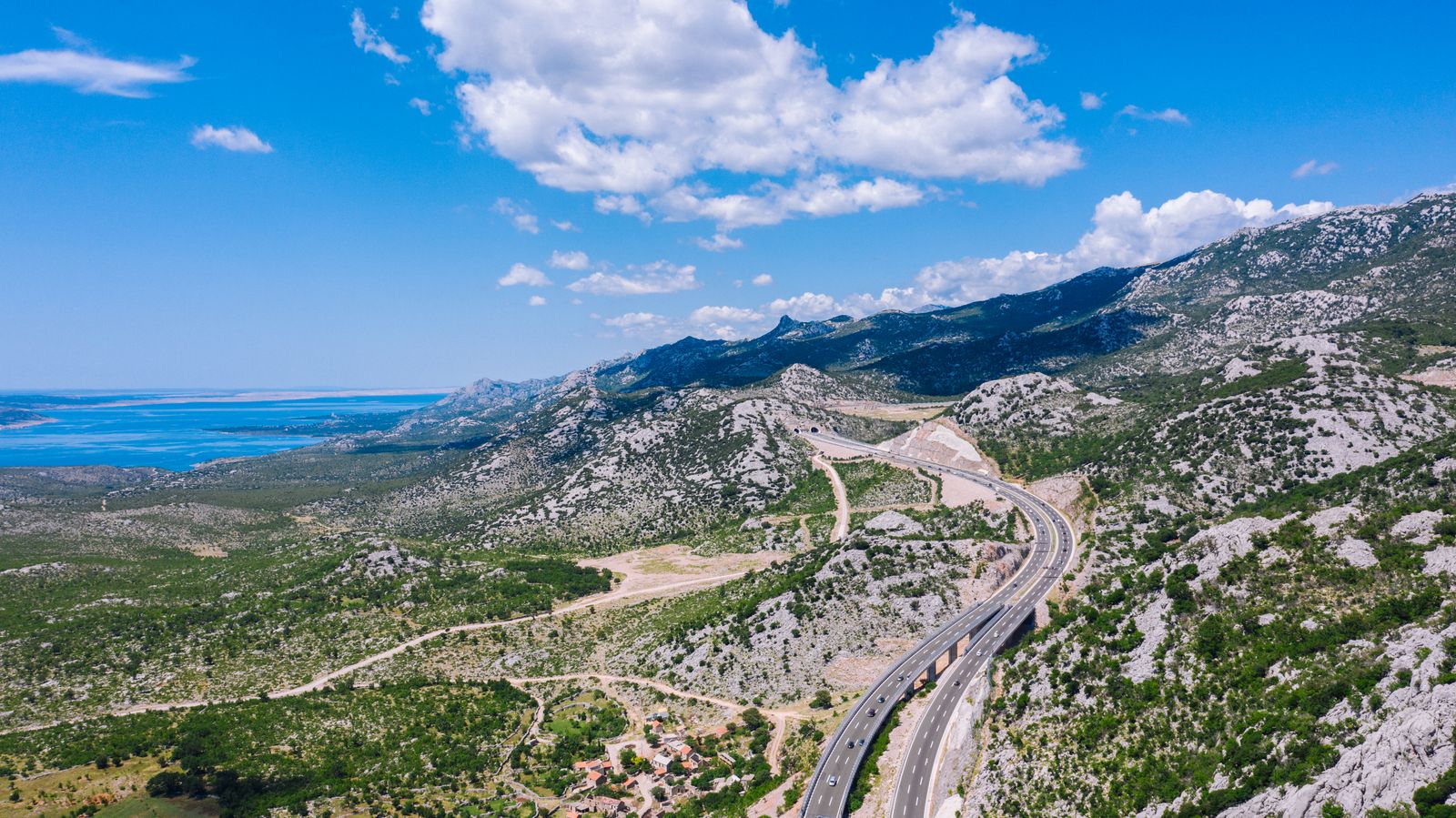
The A1 — the main route south from Zagreb through Split toward Dubrovnik — is a toll motorway. Croatia’s electronic system is called ENC, short for Elektronička naplata cestarine (electronic toll collection), not to be confused with a cashless system: cash and card lanes exist at every plaza alongside the ENC-only ones.
Almost no rental car comes fitted with an ENC transponder, so stick to the lanes marked for cash or card. Driving through an ENC-only lane without a tag gets your plate photographed and a fine mailed later.
Rough 2026 toll costs for a standard car:
| Route | Approximate cost |
|---|---|
| Zagreb → Split (A1) | around €26 |
| Zagreb → Ploče, for onward D8 to Dubrovnik | around €33 |
| Zagreb → Rijeka (A1/A6) | around €6–10 |
Istria runs its own system (the Y motorway and the Učka Tunnel), paid the same way. One thing worth knowing if you’re driving in 2027: Croatia is phasing out toll booths in favour of a fully digital, barrier-free system called Crolibertas, expected to go live in March 2027. For summer 2026 travel, the traditional booths are still exactly as described above.
The Pelješac Bridge: no more Bosnia detour
Until 2022, driving from Split to Dubrovnik meant passing through Neum — a short strip of Bosnia and Herzegovina that splits the Croatian coast — with a passport check on the way in and another on the way out. The Pelješac Bridge now connects the mainland across the bay, and the route stays entirely inside Croatia. No border, no Green Card needed for that stretch.
The bridge is toll-free. One thing to flag for anyone driving through in late 2026: renovation work is due to start in October and is expected to run into spring 2027, so there’s a real chance of delays or partial closures in that window — the old Neum road is still there and drivable as a backup if you hit it.
Crossing into Bosnia, Montenegro or Slovenia
Planning to drive further — Mostar, Kotor, Ljubljana? You’ll need a Green Card, the international motor insurance certificate, plus a written cross-border authorisation from the rental company. Most EU-issued policies include the Green Card automatically, but for a rental car it has to be arranged with the supplier, and some charge €10–50 for it depending on the destination. Sort this at booking — turning up at pickup and asking to cross into Bosnia the next morning is a common way to get told no.
Dubrovnik to Montenegro is the crossing most tourists actually use, usually for a day trip to Kotor. The checkpoint is Karasovići on the Croatian side (paired with Debeli Brijeg on the Montenegrin side), roughly 35 km south of Dubrovnik. If your insurance and paperwork aren’t sorted, don’t try your luck — you’ll be turned back, or asked to buy local cover on the spot.
Given how much this trips people up, it’s worth reading in more depth what a standard rental policy in Europe does and doesn’t cover before you rely on it across a border — see our breakdown of car rental insurance for tourists in Europe.
Getting a rental car onto the islands
Hvar, Brač, Korčula, Krk, Cres, Lošinj and dozens more are all ferry-only — except one. Krk is connected to the mainland by the toll-free Krk Bridge, which also means it’s the easiest island in the country to reach with a rental car and no ferry queue.
For the rest, most car ferries (Jadrolinija being the main operator) accept rental vehicles, but not every rental contract does — confirm with the company before you book a crossing, since a few restrict specific islands. Hvar has two options: the Split–Stari Grad ferry (about 2 hours, more frequent, arrives on the western side of the island) or the faster Drvenik–Sućuraj crossing (around 30 minutes, but drops you at the eastern tip, further from Hvar Town). In July and August, book the car slot ahead — sailings sell out.
The Split–Dubrovnik one-way
Picking up in Split and dropping off in Dubrovnik (or the reverse) is the most popular one-way route in the country, and most companies build it into the base price rather than charging a drop fee — worth confirming in writing regardless. We’ve covered the drive itself, stop by stop, in a separate guide to driving from Dubrovnik to Split: the short version is about 235 km, 3.5–4 hours on the A1 and D8, or a full day if you stop at Makarska, Ston and the Pelješac peninsula along the way.
What it actually costs
Croatia is heavily seasonal — Split and Dubrovnik airports see some of the highest peak-season prices anywhere in the Adriatic.
| Category | Low season | High season |
|---|---|---|
| Economy | €20–40/day | €55–90/day |
| Compact | €28–48/day | €65–105/day |
| Midsize SUV | €45–75/day | €90–145/day |
Compare rental prices in Croatia →
A few more things worth knowing
Book early for summer. Standard categories at Split (SPU) and Dubrovnik (DBV) airports routinely sell out by April–May for July–August pickup.
Old Town Dubrovnik is car-free. Park at Pile Gate (small, pricey) or one of the garages on the hill above the walls, and walk in — most visitors don’t try to drive inside regardless.
The D8 coastal road (the Magistrala) between Split and Dubrovnik is slower than the A1 but far more scenic, running right along the water through Makarska. Add roughly 3 hours over the motorway if you take it the whole way.
Fuel is easy to find on the mainland and the bigger islands — fill up before a ferry to somewhere smaller.
Speed limits: 50 km/h in built-up areas, 90 km/h outside them, 130 km/h on motorways.
Blood alcohol limit: 0.5 g/L for most drivers, but strict zero tolerance (0.0 g/L) if you’re under 24 or have held your licence less than two years.
Sort the toll lane, the Green Card if you’re crossing a border, and the one-way question before you pick up the keys, and the rest of driving in Croatia is genuinely straightforward.
View car rental prices in Croatia →
Ready to book your car?
Compare prices, free cancellation and pay at pickup. No surprises.
View rental prices →